
How to use this Sports Betting Prop Generation Tool
- Enter multiple projection sources with optional bias and RMSE. Choose “Inverse RMSE” weighting to auto-weight more accurate sources.
- Pick the distribution:
- Pitcher K, Outs, Hits Allowed, Hitter Hits/RBI/Runs: Negative Binomial is a good default.
- Total Bases: Lognormal or Gamma.
- Home Runs: Poisson (rare event).
- Set dispersion/shape:
- Higher θ for NB makes it closer to Poisson (less variance).
- For Gamma/Lognormal, the field controls shape/sigma respectively.
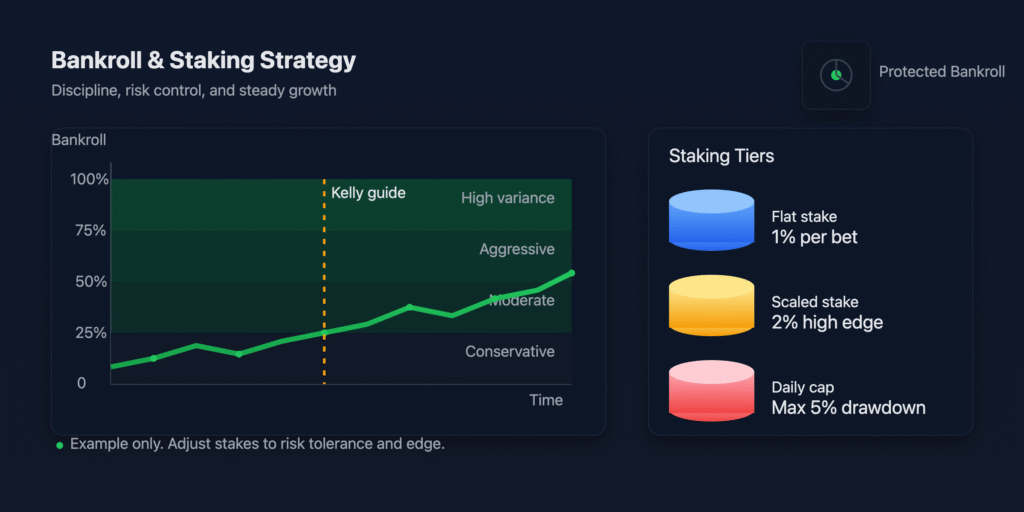
- Optional: enter a book line and both sides’ American odds. The tool removes vig, compares with your fair probabilities, and suggests Kelly stake given bankroll and fractional Kelly.
The “Projections & Calibration” area is where you paste in your player prop projections from different sources and tell the tool how much to trust each one. It then bias-corrects and weights them into a single combined mean used for pricing.
What each field means
- Source Name: Label for the projection source (e.g., “Model A”, “Site B”, “Beat Writer”).
- Projection (per game): The raw projection from that source for the chosen stat (e.g., 6.8 strikeouts).
- Weight: Only used if Weighting Scheme = Custom. Higher weight = trust more.
- Bias (actual − proj) mean: Your measured average error for this source over historical games. Example: if this source undershoots by 0.2 K on average, Bias = +0.2 so we add it to its projection.
- RMSE: Root Mean Squared Error for that source historically. Lower RMSE = more accurate/more consistent.
How to fill it effectively
- Start with 2–5 reputable sources for the same market (e.g., pitcher Ks).
- Track your own historical errors by source:
- Bias = average(actual − projection) over a rolling window (e.g., last 60–120 games per market).
- RMSE = sqrt(mean squared error) over the same window.
- Use Inverse RMSE weighting so more reliable sources influence the final number more.
- If you don’t have historical errors yet:
- Leave Bias = 0 and RMSE = 1 for all, choose Equal weighting.
- As you collect results, update bias/RMSE and switch to Inverse RMSE.
Common examples
- Example 1 (pitcher Ks):
- Model A: 6.8, Bias +0.10, RMSE 1.1
- Model B: 7.2, Bias −0.20, RMSE 0.9
- Analyst C: 6.5, Bias 0.00, RMSE 1.4
- Scheme: Inverse RMSE → Model B gets the most weight; final μ might be ~6.9–7.0 after bias-correcting.
- Example 2 (hitter hits):
- If an analyst tends to over-project stars by 0.05 hits, set Bias = +0.05 (actual − proj is positive), which nudges their projections up before blending.
Why this matters
- Bias correction removes systematic over/under-shooting by a source.
- Error-based weighting reduces noise by leaning on sources that historically forecast better for that stat/player type.