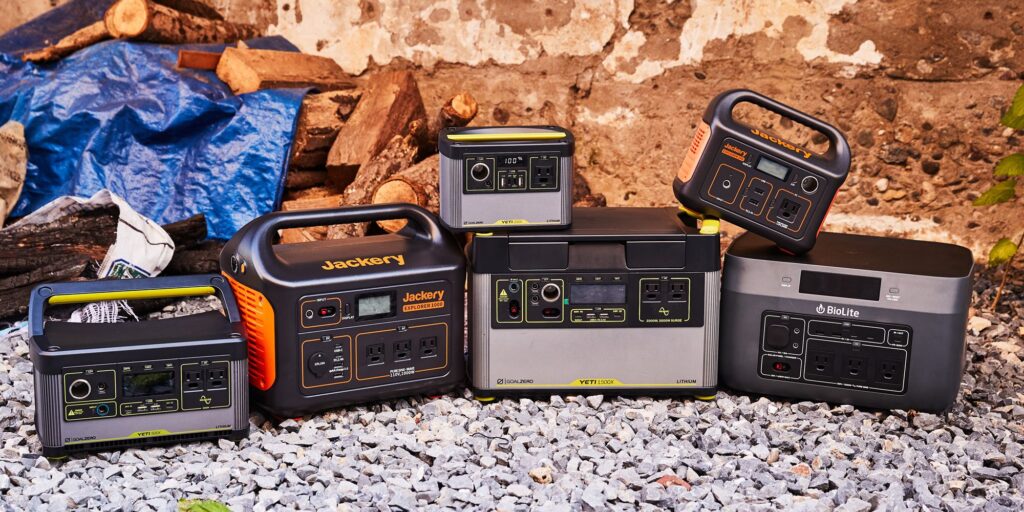
From 300Wh grab‑and‑go units to 2kWh home backup beasts, we tested real‑world runtimes, charging speed, and inverter quality so you can buy once and rely on it.
How we picked these power stations
We focused on practical factors that matter in the field: usable watt‑hours under typical loads, inverter quality for sensitive electronics, noise and heat, recharge options (AC, solar, car), and how quickly you can go from empty to 80%.
If you just want the top choice for your situation, start with the TL;DR. For details on capacity sizing, solar panel pairing, and battery chemistry (LiFePO₄ vs NMC), see the buying guide below.
TL;DR: Quick picks
- Best overall 1kWh class: EcoFlow DELTA 2 — fast AC recharge, solid app, modular expansion.
- Best home backup (~2kWh): Jackery Explorer 2000 Plus — high surge, quiet operation, expansion batteries.
- Best budget 500–600Wh: BLUETTI EB55 — LiFePO₄ longevity and many ports under $500.
- Best for camping vans: Anker PowerHouse 767 — robust wheels/handle, great UPS and 2400W output.
- Best ultra‑portable (~300Wh): Goal Zero Yeti 300 — compact, regulated 12V, reliable build.
- Best solar bundle value: EcoFlow RIVER 2 Pro + 220W panel — fast solar input for weekend trips.

Best overall 1kWh class: EcoFlow DELTA 2
Why it’s great
Excellent balance of capacity (1024Wh), speedy AC charging (0–80% ≈ 50 minutes), and a polished app. Stack an expansion battery if you outgrow it.
Pros
- Very fast wall charging
- Smart app with charge limits
- Expandable capacity
Cons
- Fans audible at high load
- Heavier than some 1kWh rivals
Manual price entry. Update as needed.

Best home backup (~2kWh): Jackery Explorer 2000 Plus
Why it’s great
High continuous output for fridges and power tools, quiet fans, and stackable batteries for multi‑day outages. Jackery’s ecosystem and support are mature.
Pros
- Great surge handling
- Quiet under moderate loads
- Expandable system
Cons
- Accessories add up in cost
- Heavy to move solo
Manual price entry. Update as needed.

Best budget 500–600Wh: BLUETTI EB55
Why it’s great
LiFePO₄ cells promise long cycle life, and you get a generous port selection (4 AC outlets) plus dual recharge inputs. Great value if you don’t need 1kWh.
Pros
- Excellent longevity per dollar
- Many AC/DC ports for size
- Solar + AC simultaneous charging
Cons
- Screen is basic
- Slower wall charging
Manual price entry. Update as needed.

Best for camping vans: Anker PowerHouse 767
Why it’s great
Big inverter (up to 2400W) for induction cooktops and heaters, UPS‑like pass‑through keeps gear powered, and wheels/handle make its weight manageable.
Pros
- Household‑grade power output
- Well‑designed mobility
- Good UPS behavior
Cons
- Bulky for apartments
- Pricey without bundles
Manual price entry. Update as needed.

Best ultra‑portable (~300Wh): Goal Zero Yeti 300
Why it’s great
Light, compact, and with a regulated 12V port that plays nicely with coolers and routers. Perfect for short trips and small device backup.
Pros
- Very portable
- Regulated 12V output
- Trusted build quality
Cons
- Limited AC output
- Screen is minimal
Manual price entry. Update as needed.

Best solar bundle value: EcoFlow RIVER 2 Pro + 220W panel
Why it’s great
Fast solar input and quick AC top‑ups make this a great weekend warrior setup. The app’s charge limits protect the battery if you store it full.
Pros
- Quick solar harvesting
- Very fast wall charging
- Good value in bundles
Cons
- Not for heavy appliances
- Panel adds bulk to pack
Manual price entry. Update as needed.
Quick comparison
EcoFlow DELTA 2
1024Wh (expandable)
All‑round home/camp
Jackery Explorer 2000 Plus
2042Wh (expandable)
Outages, tools
BLUETTI EB55
537Wh
Budget, weekenders
Anker PowerHouse 767
2048Wh
Vans, high‑draw gear
Goal Zero Yeti 300
~300Wh
Ultralight backup
RIVER 2 Pro + 220W solar
768Wh
Solar‑friendly trips
How we test power stations
- Inverter quality: Oscilloscope check for sine‑wave stability; laptop/monitor compatibility.
- Runtime: 100W and 300W constant‑load tests to shutdown; log usable Wh vs rated Wh.
- Recharge speed: AC 0–80% time; solar input at 200–800W in mixed sun.
- Noise/thermals: Fan dB at 1m under 300W load; surface temps with IR camera.
- Port mix: Count and test AC/DC/USB‑C PD outputs; 12V regulated behavior.
- App and firmware: Charge limits, UPS settings, and firmware reliability.
- Durability: Handle/wheel robustness, drop/transport considerations.
Buying guide: Choose the right capacity
- Quick math: Add up device watts × hours. Example: 60W laptop × 5h = 300Wh; add 20–30% overhead.
- Chemistry: LiFePO₄ lasts 3000+ cycles and tolerates heat better; NMC is lighter with higher energy density.
- Inverter size: For kitchen appliances or power tools, look for 1500–2400W continuous output with high surge.
- Solar pairing: Aim for 200–400W panels for ~1kWh units; check open‑circuit voltage limits and connectors (XT60, MC4).
- Ports and 12V: If you run fridges/routers, prioritize regulated 12V outputs and multiple USB‑C PD ports (60–100W).
- Noise and cooling: Quieter fans matter in bedrooms and offices; larger units often spin up under load.
- Weight and mobility: Over ~20kg, wheels/handles are a must; consider where you’ll store and move it.
- Safety and storage: Store around 50–60% charge if unused for months; avoid sealed hot spaces.
FAQ
Can a power station run a refrigerator?
Yes, most 1–2kWh units with 1000W+ inverters can handle typical fridges. Check surge ratings and plan capacity for several hours of runtime.
Is LiFePO₄ worth it?
For frequent use and longevity, yes—cycle life is much higher. NMC is fine if you need lighter weight and lower upfront cost.
How fast can I charge from solar?
Expect roughly 100–600W depending on panels and sun. A 220W panel in good sun may add ~150–180W actual.
Can I use it as a UPS?
Some models support pass‑through/UPS with transfer times under 20ms—fine for PCs and networking gear.
What size do I need for camping?
300–800Wh covers lights, phones, cameras, and a laptop. Add capacity for induction cooking or heaters.