Bankroll and Staking Planner
Plan stakes using Flat, Kelly, or Fractional Kelly. Includes risk-of-ruin and drawdown simulation. Aligns with your guide’s advice on variance, correlation, and edge uncertainty. SEE THE BOTTOM OF ARTICLE FOR TERMINOLOGY AND USAGE.
Enter like +120, -145, or decimal 1.91
Your EV per bet. Example: 3%.
Higher uncertainty ⇒ smaller Kelly fraction.
0 diversified, 0.3–0.6 clustered props/SGPs.
Stake recommendations
Breakeven probability
—
Fair probability (with edge)
—
Flat stake
—
Kelly stake (adjusted)
—
Risk metrics (Monte Carlo)
Risk of ruin
—
Expected max drawdown
—
P5 / P50 / P95 Final BR
—
Longest losing streak (median)
—
Bankroll percentile paths
Notes: Fractional Kelly follows your selected fraction but is also damped for edge uncertainty (per your guide: size down when assumptions are fragile). Correlation increases variance and drawdowns, especially for clustered player props/SGPs.
Part 1 — How to use the Bankroll and Staking Planner
What this tool helps you do
- Size your bets using Flat, Kelly, or Fractional Kelly methods.
- Translate your estimated edge into a fair win probability.
- See variance impacts from correlation between bets.
- Simulate risk of ruin, expected drawdowns, and bankroll percentile paths over N bets.
Step-by-step setup
- Enter bankroll
- Put your active betting bankroll, not your net worth. Example: 1,000.
- Select odds format and enter odds
- American: +120, -145. Decimal: 1.83, 2.10. The app auto-converts internally.
- Enter estimated edge (%)
- This is your expected ROI per bet relative to the book’s price.
- If your model makes a line -110 fair and you’re offered -105, your edge is roughly 2.4%.
- If you’re unsure, start small (1–2%) and validate with CLV tracking.
- Edge uncertainty (stdev, %)
- How noisy is your edge? If your edges swing ±1–2% in backtests, enter that.
- Higher uncertainty automatically reduces Kelly sizing (safer by design).
- Fractional Kelly
- Choose 25–50% Kelly if you’re still validating a model or betting props.
- Full Kelly is aggressive and can have sharp drawdowns; most pros go 20–50%.
- Flat stake (% of bankroll)
- If you prefer flat bets, specify a percentage (e.g., 0.5–1% for main markets, 0.25–0.5% for props).
- Simulation inputs
- Sim bets (N): How many sequential bets to simulate (e.g., 500).
- Correlation ρ: 0.0 for diversified bets across games/markets; 0.3–0.6 for clustered props/SGPs.
- Monte Carlo runs: 1,000–5,000 for smoother percentiles.
Click “Calculate & Simulate.”
Reading the outputs
- Breakeven probability: The win rate you need at the entered odds to break even with zero edge.
- Fair probability (with edge): Your implied true win probability after applying your edge.
- Flat stake: The fixed dollar stake per bet if you use flat staking.
- Kelly stake (adjusted): Kelly bet size today, factoring in your Kelly fraction and edge uncertainty.
Risk metrics
- Risk of ruin: Probability of ending near broke (95%+ bankroll loss) over N bets.
- Expected max drawdown: Typical deepest dip from a prior peak over N bets.
- P5 / P50 / P95 Final BR: 5th/50th/95th percentile ending bankroll; a quick sense of downside, typical, and upside. Effectively the lowest your betting will give you and the highest it will give you based on law of large numbers and percentage edge. In short, this shows you how wild variance is.
- Longest losing streak: Median longest skid you should expect in that run.
Percentile chart
- Blue band = Kelly path (median + 5–95% envelope).
- Gray band = Flat path.
- If the bands are very wide or skew down early, you’re sizing too aggressively or correlation is high.
Practical presets
- Main markets (NFL sides, NBA totals): Edge 1–3%, uncertainty 0.5–1.5%, Kelly 25–50%, flat 0.5–1%.
- Player props: Edge 2–5% (be conservative), uncertainty 1.5–3%+, Kelly 10–33% (select 25% in the app), flat 0.25–0.5%.
- Same Game Parlays or clustered props: Increase ρ to 0.3–0.6 and expect bigger drawdowns; size down.
Common usage patterns
- Validating a model: Use flat 0.5–1% and track CLV. Move to 25–50% Kelly once you consistently beat the close.
- Scaling up: Increase Kelly fraction slowly as edge uncertainty falls. Keep ρ low by diversifying scripts.
- High volatility week (injuries/weather): Temporarily lower Kelly fraction or switch to flat stakes.
Red flags and what to do
- High risk of ruin or deep expected drawdown: Reduce fractional Kelly or lower your edge input.
- Kelly stake > 2–3% of bankroll at even odds: Consider your edge/uncertainty inputs; you might be overconfident.
- Big correlation (ρ ≥ 0.3): Spread exposure across different games/markets or size down.
Worked examples
- Even odds, modest edge
- Bankroll 1,000; odds +100 (2.00); edge 2%; uncertainty 1%; 50% Kelly; ρ=0.1; N=500.
- Expect Kelly stake ≈ 1–2% of bankroll, low but real growth, moderate drawdowns.
- Props with correlation
- Same as above but edge 3%, uncertainty 2%, ρ=0.5 (stacked WR/QB overs).
- Kelly stake will be damped; drawdown and losing-streak metrics jump. Consider 25% Kelly or flat 0.25–0.5%.
Part 2 — Terminology guide
Core concepts
- Expected Value (EV): The average profit you’d make per bet if you could repeat it forever. Positive EV (+EV) means profitable in the long run; negative EV (−EV) means losing over time.
- Edge: Your expected ROI relative to the bookmaker’s price. If your fair line implies you should win 52.5% at -110 and the breakeven is 52.38%, your edge is about 0.12%.
- Variance: How widely results can swing around your expectation. High variance means larger, more frequent drawdowns and streaks.
- Volatility vs. Edge: Volatility says nothing about profitability—high-vol bets can be +EV or −EV.
Odds and probabilities
- American odds: +120 means risk 100 to win 120; -150 means risk 150 to win 100.
- Decimal odds: 2.10 means total return of 2.10 per 1 staked (profit 1.10).
- Breakeven probability: The win rate you need to not lose money at a given price. For decimal d, breakeven = 1/d.
- Fair probability (with edge): Your model’s true win chance after applying your edge. The app computes p_fair from your edge and odds.
Staking methods
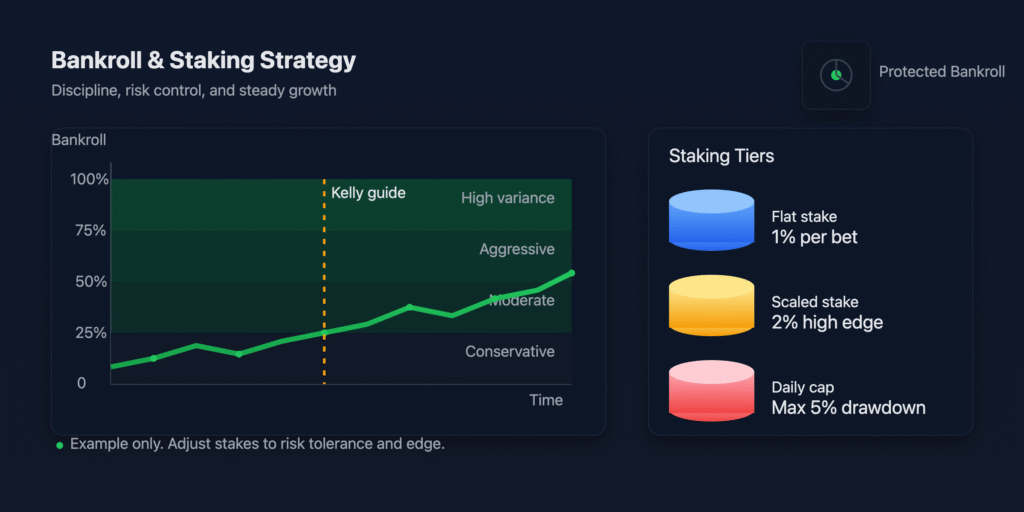
- Flat staking: Risk the same fixed amount (or fixed % of bankroll) each bet. Simple and variance-friendly.
- Kelly Criterion: Optimal growth sizing under perfect information: f = (b·p − q)/b where b is odds-1, p is your fair probability, q = 1−p. Full Kelly is aggressive.
- Fractional Kelly: A safer portion of Kelly (e.g., 25–50%) to reduce drawdowns when your edge estimate is uncertain.
Risk metrics and simulation
- Monte Carlo simulation: Repeats many random paths of wins/losses to estimate your bankroll distribution, risk of ruin, and drawdowns.
- Risk of ruin (RoR): Probability your bankroll effectively goes to zero (or a defined threshold) over N bets—even with a positive edge—due to variance.
- Max drawdown (MDD): Largest peak-to-trough drop in your bankroll across the run.
- Longest losing streak: The longest run of consecutive losses; grows as your edge gets smaller and as correlation rises.
- Percentile bands (P5/P50/P95): Where your ending bankroll lands in pessimistic (5th), typical (50th), and optimistic (95th) scenarios.
Correlation and market structure
- Correlation (ρ): How much your bet outcomes move together. Stacking correlated props (e.g., QB over + WR1 over + game over) raises variance and drawdowns.
- Same Game Parlay (SGP): Multi-leg bet within one game. Books adjust for correlation, but not always perfectly. Correlation can both create edge and amplify variance.
- Market cycle (open → close): Early lines have more uncertainty and move more; limits are lower. Close is sharpest, with higher limits and less price variance.
Player props and distribution shape
- Right-skewed/Zero-inflated distributions: Props like receptions, assists, goals, and home runs aren’t symmetric. Mean and median differ. This makes “overs” and “unders” behave differently than a simple normal model would suggest.
- Role uncertainty: Minutes, snaps, rotations, fouls, pitch counts. Small role changes can shift fair prices materially.
Bankroll discipline
- Regression to the mean: Extreme hot/cold spells usually cool off over larger samples.
- Small samples need bigger edges: A 2–3% edge can take hundreds or thousands of bets before it clearly shows up.
- CLV (Closing Line Value): Beating the closing number is the best early sign your process has edge, even if short-term profit lags.
Actionable heuristics
- Size down when assumptions are fragile (injury news, weather windows, minutes caps).
- Prefer fractional Kelly (20–50%) while validating. Use flat staking if edge estimates are noisy.
- Diversify scripts to keep ρ low: Mix overs and unders, avoid stacking the same narrative.
- Track your own volatility: Expect 2–3 standard deviation drawdowns several times per season.
FAQ
- How do I choose Kelly fraction?
- If you’re new or betting props: 25–33%. If you’ve proven edge and beat CLV consistently: 33–50%. Full Kelly only with very robust models.
- What correlation value should I use?
- 0.0–0.15 for mixed markets across games. 0.3–0.6 for stacked props/SGPs within a single game. When in doubt, err higher—it’s safer.
- What if my risk of ruin looks high?
- Lower Kelly fraction, reduce flat % stake, or reduce correlation by diversifying bets.
- Should I change stake after wins/losses?
- Kelly adjusts with bankroll automatically. Flat staking keeps it constant; you can rebalance monthly to a % of bankroll if you prefer stability.