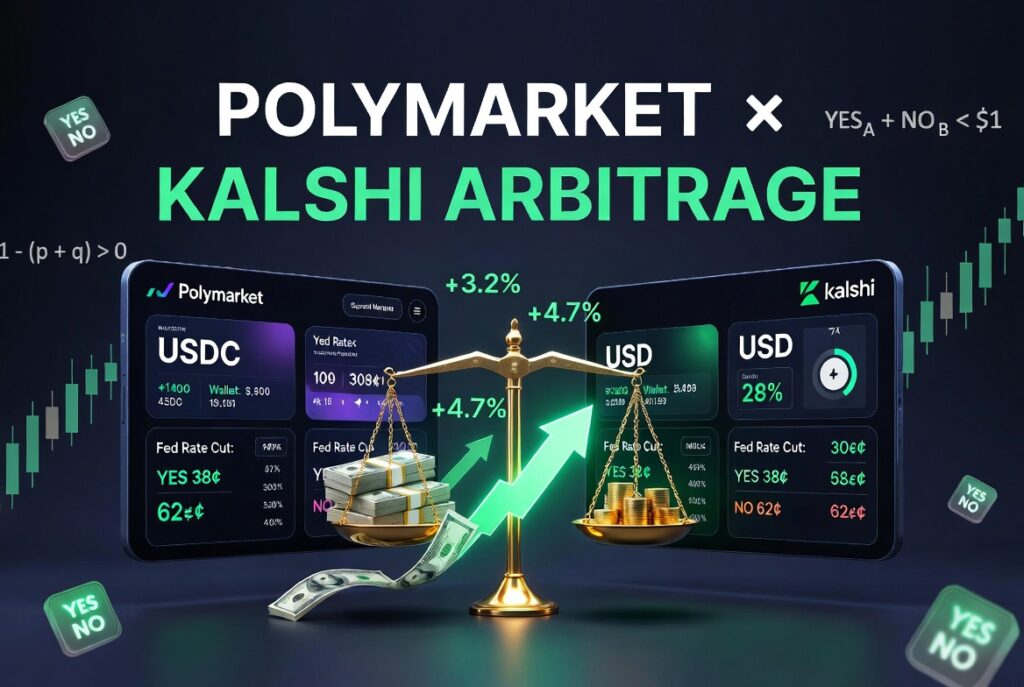
Prediction markets exploded in 2025–2026. Polymarket and Kalshi now handle billions in weekly volume on everything from Fed rate decisions to NBA championship outrights to niche crypto milestones. The biggest edge for sharp traders isn’t picking winners — it’s arbitrage: exploiting the same event priced differently across the two platforms to lock in guaranteed profit no matter the outcome.
This isn’t gambling. It’s mathematical mispricing. When the combined cost of a YES on one platform and a NO on the other falls below $1.00 (after fees), you buy both sides and collect the difference at resolution. Gaps of 2–6¢ appear regularly. Scaled with proper execution, they compound into serious money.
Here’s the complete playbook: how it works, step-by-step execution, fees that actually matter, best/worst practices, real edges, and the risks that can still bite you.
1. Quick Platform Comparison (2026 Reality)
| Aspect | Polymarket (Global + US via FCM) | Kalshi (CFTC-Regulated) |
|---|---|---|
| Currency | USDC (Polygon) | USD (bank/ACH) |
| Trading Fees | 0% on most markets (politics, econ, sports); 0.10% taker on US venue or fee-enabled short-term markets | Dynamic taker: ~0.07 × P × (1-P) per contract (max 1.75¢ at 50¢); makers often 0% or low |
| Deposit/Withdrawal | Free platform; tiny Polygon gas (~$0.01–0.05); instant | ACH free; debit 2%; 1–3 business days |
| Liquidity | Stronger in politics, crypto, long-term events | Stronger in US sports, econ data, short-term |
| User Base | Crypto-native, international + US | US retail/institutional, more “traditional” |
| Resolution | UMA oracle + community (transparent but occasional disputes) | Internal + official sources (faster, fewer disputes) |
| Access (US) | Available via US venue or global (check eligibility) | Fully legal for US users (KYC required) |
| Idle Yield | None built-in | ~3.75–4% APY on cash balances |
Polymarket usually wins on fees and speed. Kalshi wins on fiat ease and some liquidity pockets. The arbitrage edge comes from their fragmented user bases — one platform overreacts to news, the other lags.
2. The Math: How Arbitrage Actually Works
Every binary contract pays $1 if correct, $0 if wrong. In a perfect world:
YES price + NO price = $1.00
When it doesn’t, arbitrage exists.
Cross-platform formula (the money-maker):
Let p p p = YES price on Platform A Let q q q = YES price on Platform B
Buy YES on the cheaper platform + NO on the more expensive one (i.e., buy the side priced at 1−q 1 – q 1−q).
Gross spread = 1−(p+(1−q))=q−p 1 – (p + (1 – q)) = q – p 1−(p+(1−q))=q−p (if positive)
Or more simply: Combined cost = YES_A + NO_B If Combined cost < $1.00, gross profit = 1− 1 – 1− Combined cost
Net profit = Gross spread − (Fees_A + Fees_B + slippage estimate)
Example (realistic 2026 Fed rate market) Kalshi YES = 38¢ Polymarket NO = 57¢ Combined cost = 95¢ → Gross spread = 5¢ per contract
Kalshi taker fee at 38¢ ≈ 1.7¢ Polymarket fee = 0¢ (standard market) Net ≈ 3.3¢ per contract
On 1,000 contracts:
- Capital tied up: $950
- Gross profit: $50
- Fees: $17
- Net profit: $33 (3.47% in ~60 days → ~21% annualized)
Scale to $10k+ and rotate capital on convergence (see below) and it becomes daily income.
3. Step-by-Step Execution Guide
- Setup
- Verified accounts on both platforms (KYC on Kalshi; wallet + USDC on Polymarket).
- Pre-fund both (keep $2k–$10k liquid on each).
- Open side-by-side tabs or use a dashboard/scanner.
- Find Matching Markets
- Search identical wording: “Will the Fed cut rates in March 2026?” or “Will Bitcoin hit $150k by June 30?”
- Best categories right now: Fed/CPI/NFP releases, political policy votes, crypto milestones, major sports outrights.
- Calculate Real Spread
- Pull live prices (bid/ask mid or better).
- Add fees using each platform’s formula.
- Estimate slippage (0.5–2¢ on liquid markets; worse on thin ones).
- Only proceed if net spread ≥ 2¢ after everything.
- Execute
- Order type matters: Use limit orders (maker) on Polymarket to pay 0 fees.
- Hit the faster-updating leg first (usually Kalshi).
- Set small time window (30–60 seconds) — if one side doesn’t fill, cancel the other.
- Size: Start at 100–500 contracts; scale only after you have 5–10 successful cycles.
- Exit Strategy
- Hold to resolution (safest, true arb) OR
- Trade the convergence: When spread narrows, sell both legs early for faster capital turnover (most pros do this — 2% every 2–3 days beats 3% every 60 days).
4. Fees: The Silent Killer (2026 Breakdown)
- Polymarket: Near-zero on 90%+ of arb-friendly markets. Maker rebates on fee-enabled ones.
- Kalshi: Parabolic formula hurts 40–60¢ contracts most. Always calculate exactly.
- Hidden costs: Slippage (biggest on large sizes), capital opportunity cost, gas/ACH delays.
Rule of thumb: Target gross spreads ≥ 3–4¢ to stay profitable after real-world friction.
5. Dos and Don’ts
Do‘s
- Pre-calculate everything (use a spreadsheet or calculator).
- Use maker orders aggressively on Polymarket.
- Automate with bots/scanners (see Tools).
- Check resolution criteria word-for-word on both platforms before trading.
- Diversify across 3–5 markets at once.
- Track every trade for taxes.
- Start small and prove the process.
Don’t
- Ignore fees or slippage — a 3¢ gross spread can turn negative instantly.
- Trade illiquid/thin markets with big size (partial fill = directional risk).
- Use VPNs to bypass restrictions (account freezes).
- Chase every 1¢ gap — transaction costs kill them.
- Hold capital in one platform forever (rotate via convergence).
- Assume identical resolution — wording differences have caused payouts to diverge.
6. The Real Edges (Why These Gaps Keep Appearing)
- User-Base Fragmentation — Polymarket = crypto degens & international; Kalshi = US sports bettors & institutions. News hits one harder.
- Liquidity & Speed Differences — Kalshi updates slower on some events → temporary lags.
- Event Timing Windows — 24–48 hours before econ releases or policy votes = widest spreads.
- Maker Rebates + Zero Fees on Polymarket — You can capture the full spread others can’t.
- Convergence Trading — Most pros don’t hold to resolution. They enter on divergence, exit on convergence → 10–20x higher capital velocity.
- Scalability — Once automated, a 2–3% edge compounds daily across dozens of markets.
Academic studies and on-chain data show tens of millions extracted in arbitrage profits on these platforms alone.
7. Risks (Be Honest With Yourself)
- Resolution Risk (biggest): Different oracles/wording → one platform pays YES, the other NO.
- Execution Risk: One leg fills, the other doesn’t → you’re now directional.
- Liquidity/Slippage Risk: Price moves against you mid-execution.
- Capital Lockup: Money tied for weeks/months (mitigate with convergence trading).
- Platform/Regulatory Risk: Both are young; rules can change.
- Taxes: Kalshi issues 1099s; Polymarket is blockchain (self-report). Treat as capital gains or consult a pro — no clear IRS guidance yet.
8. Tools & Automation (2026 Meta)
- Manual: Eventarb.com calculators, side-by-side tabs.
- Scanners: OddsJam (includes prediction markets), custom Discord alerts.
- Bots: Open-source GitHub repos for Polymarket-Kalshi arb (Rust/Python). Many pros run 24/7 scanners.
- Dashboards: Laika Labs-style monitors for live spread alerts.
Bots turn this from a hobby into a business.
9. Legal & Tax Notes for US Users (Nashville, TN)
- Kalshi: Fully legal and CFTC-regulated.
- Polymarket: Accessible via US venue or global (verify your state).
- Taxes: Track cost basis, fees, and resolution. Expect ordinary income or 60/40 treatment on CFTC contracts. Use a spreadsheet or crypto tax software.
Realistic Expectations & Final Thoughts
This isn’t “set and forget” passive income. The best arbitrageurs treat it like a high-frequency trading desk: scanners running 24/7, strict risk rules, and constant optimization. A disciplined operator with $20k–$50k rotating capital can realistically target 1–3% per week net (after fees/slippage) on the best days — more during volatile periods.
Start manual. Prove 10 clean trades. Then automate. The edges are real, the math is ironclad, and the opportunity is still wide open in 2026 because retail money keeps pouring in and creating mispricings.
The market isn’t efficient yet. That’s your edge.
Now go open those tabs and start hunting.
(Pro tip: Bookmark the fee calculators and resolution rules pages. The first 5 successful arbs will pay for any tools you buy.)
Happy arbitraging — and may your combined YES + NO always land under 98¢.
Drop questions in the comments if you want spreadsheet templates or bot setup walkthroughs. I’ll update this guide as fee structures or regulations evolve.